
SHOCKWAVE THERAPY · HUNTINGTON, NY
Shockwave Therapy for Shin Splints (MTSS) in Huntington, NY
Shin pain that returns the moment you start running again? Focused acoustic-wave therapy, paired with a graded return-to-running plan, speeds recovery from medial tibial stress syndrome — getting runners back to training faster than rest alone.
Same day appointments may be available.
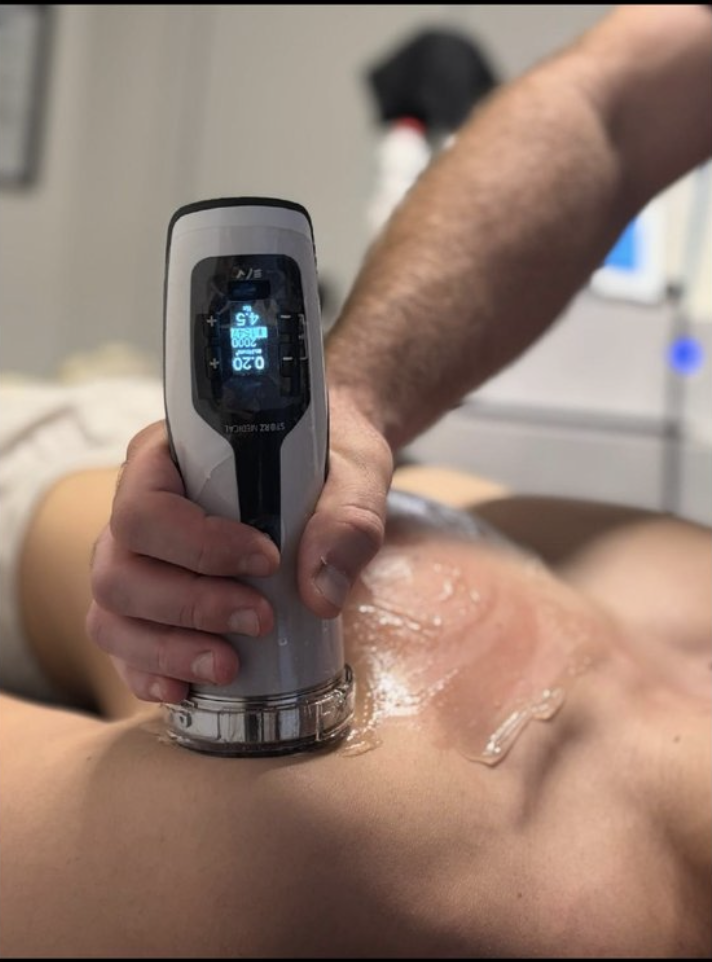
Shockwave therapy for shin splints — medial tibial stress syndrome (MTSS) — uses focused acoustic waves to speed recovery of the painful tissue along the shin bone. At West Hills Chiropractic Pain Center in Huntington, NY, we combine focused Storz Medical shockwave with a graded return-to-running plan to get runners and active adults back to training faster than rest alone. Non-surgical, no downtime.
Why shin splints sideline runners for so long
Shin splints are pain along the inner edge of the shin bone, brought on by running and impact, common when you ramp up training too fast. Up to a third of runners deal with MTSS, and the maddening part is how long it lingers: the standard advice is rest, but the pain returns the moment you start running again, so athletes get stuck in a stop-start cycle for months. There hasn’t been a clearly superior treatment — which is exactly where shockwave has earned attention.
How shockwave therapy treats shin splints
Focused pulses to the painful region of the tibia stimulate bone and soft-tissue healing — increasing blood flow and the repair response in tissue that’s been overloaded faster than it can adapt. We pair it with a structured, graded running program so you reload the leg progressively instead of all at once.
What the research shows
Shin splints is one of the few MTSS treatments with controlled evidence behind it:
- A single-blind randomized controlled trial in military cadets found that focused shockwave plus an exercise program produced an 82.6% success rate at four weeks (Gómez-Garcia et al., 2017).
- A prospective controlled study in athletes found that adding shockwave to a graded running program produced significantly faster full recovery (about 60 days vs. 92 days with the running program alone) (Rompe et al.).
Faster return to running, with the same kind of graded loading you’d do anyway — that’s the appeal.
Are you a candidate?
A good fit if you have shin pain from running/impact that keeps returning when you resume training, and you want to recover faster than rest alone. Important: we first rule out a tibial stress fracture, which causes more focal pain and needs different management — shockwave is for MTSS, not for an active stress fracture.
What to expect
- Evaluation to confirm MTSS and rule out a stress fracture.
- Treatment: five to ten minutes of focused pulses along the shin; firm tapping, no numbing.
- No downtime.
- A short series of about three to five sessions over several weeks.
- Graded running program alongside — central to getting you back without re-injury. Recovery is typically faster than rest alone.
How it compares
| Option | Gets you back to running? | Trade-off |
|---|---|---|
| Rest alone | Eventually | Slow; pain often returns on resuming |
| NSAIDs | No | Symptom control only |
| Orthotics / gait changes | Helps prevent recurrence | Doesn’t speed current recovery much |
| Shockwave + graded running | Yes — faster | Controlled studies show quicker return to running |
FAQ
Frequently asked questions
Does it hurt?
A firm tapping along the shin; tolerable and no anesthesia. (Effective shockwave does require a real therapeutic intensity — “painless” treatment may be under-dosed.)
How many sessions?
Usually three to five over several weeks, alongside a graded running plan.
Can I keep running?
We’ll guide a graded return rather than full rest in most cases — progressive loading is part of the treatment.
How is this different from a stress fracture?
A stress fracture is more focal and needs different management; we screen for it first. Shockwave is for MTSS.
Why the running program?
Because the studies that worked combined shockwave with graded loading — that pairing is what speeds recovery.
Insurance?
Coverage varies; often out-of-pocket. We explain costs first.
Related care at West Hills
- Shockwave therapy overview — how focused ESWT works and every condition we treat with it.
- Sports rehabilitation — graded return-to-running and return-to-sport programming.
- Physical rehabilitation — the loading and gait work we pair with shockwave.
Reviewed by the clinical team at West Hills Chiropractic Pain Center · Huntington, NY · Last reviewed May 2026
START YOUR RECOVERY
Ready to get back to running faster?
Find out whether focused shockwave can speed your recovery from shin splints. We’ll confirm it’s MTSS and rule out a stress fracture first.
400 W Jericho Turnpike, Huntington, NY 11743
Mon 8am–6pm · Tue 7am–6pm · Wed 8am–7pm · Thu 7am–6pm · Fri 8am–6pm · Sat 8am–12pm