
SHOCKWAVE THERAPY · HUNTINGTON, NY
Focused Shockwave Therapy in Huntington, NY
More than a machine: focused STORZ Medical technology, more than a decade of clinical experience, and rehabilitation built around the diagnosis.
THE SHORT VERSION
What Shockwave Therapy Is
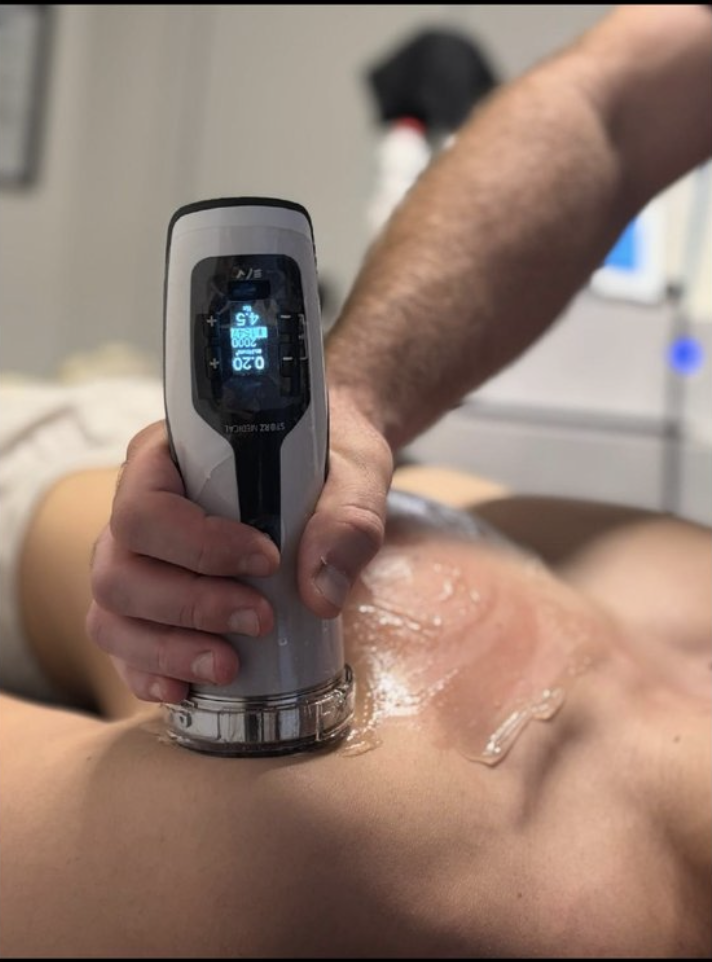
Shockwave therapy—also called extracorporeal shockwave therapy or ESWT—uses acoustic pressure waves applied to a selected treatment area. At West Hills, the difference is not simply owning a device. We use focused STORZ Medical technology, keep radial pressure wave available for broader treatment fields, and decide between them from the diagnosis, target depth, anatomy, and rehabilitation plan.
HOW WE USE IT
Diagnosis First. Device Second.
Persistent tendon and heel pain can look similar while requiring different decisions. We first identify the likely structure, how it responds to loading, what has already been tried, and whether the presentation matches evidence for shockwave.
Focused ESWT creates a defined focal treatment zone at a selected depth. Radial pressure wave distributes energy more broadly near the applicator. West Hills generally favors focused treatment when the evaluation identifies an appropriate localized, depth-specific target; radial may fit a broader or more superficial field.
The technology is then integrated with progressive loading, activity planning, and measurable functional goals. The assurance is in the process: you should understand why a device was selected, what outcome will be tracked, and when the plan will be reconsidered.
NOT ALL SHOCKWAVE IS EQUAL
Focused Shockwave vs. Radial Pressure Waves
“Shockwave” gets used as a catch-all, but there are two very different technologies hiding under that one word — and the distinction has real clinical consequences.
Radial pressure waves
Made by firing a small projectile against an applicator with compressed air. The energy is strongest right at the skin and fades quickly with depth — useful for superficial, broad areas, but it can’t concentrate force on a structure that sits an inch or more below the surface. Often branded “EPAT.”
Focused shockwave
Generated inside the applicator and focused — like light through a lens — to a precise point at a chosen depth. That puts therapeutic energy exactly on a deep rotator cuff tendon, a calcium deposit, or the origin of the plantar fascia. Individual randomized trials have favored focused treatment for certain diagnoses, while other comparisons have found no significant difference. The result should not be turned into a universal superiority claim.
Here’s why this matters if you’re comparing providers in Huntington: ask what device is being used, whether it is focused or radial, why that treatment field matches the target, and how response will be measured. West Hills can make that choice because we have focused STORZ technology, radial treatment when appropriate, and more than a decade of focused-shockwave experience.
MSK Conditions We Treat With Shockwave
WHAT WE TREAT
The strongest musculoskeletal evidence clusters around selected persistent tendon, plantar-fascia, and calcific presentations. The conditions we evaluate most often at our Huntington clinic include:
Plantar fasciitis & heel pain
The most common and best-studied use — focused energy delivered right at the origin of the plantar fascia.
Tennis elbow
Lateral epicondylitis — pain on the outside of the elbow that gripping and lifting make worse.
Golfer’s elbow
Medial epicondylitis—inner-elbow pain commonly aggravated by gripping and loading.
Rotator cuff & calcific tendinitis
Shoulder presentations including selected rotator-cuff and calcific-tendon findings, evaluated against the evidence and examination.
Achilles tendinopathy
Both mid-portion and insertional — common in runners and a frequent reason people come in.
Patellar tendinopathy
Jumper’s knee — front-of-knee pain in jumping and running athletes.
Greater trochanteric / hip tendinopathy
Pain on the outside of the hip that’s slow to settle with rest alone.
Shin & stress-related bone pain
Plus other chronic tendon strains — evaluated case by case to confirm shockwave is the right fit.
Shockwave is also a strong fit alongside our other services. Many patients combine it with physical rehabilitation and corrective exercise so the tendon is both stimulated and reloaded properly, and patients with overlapping spine issues are often already seeing us for non-surgical spinal decompression.
THE EVIDENCE
What the Research Says
Shockwave isn’t a fringe therapy — it has a solid base of randomized trials and systematic reviews behind it. A few of the studies we point patients to:
Plantar fasciitis
A 2024 systematic review of 14 randomized trials (867 patients) found ESWT measurably reduced the thickened plantar fascia seen on ultrasound (Simental-Mendía et al., Arch Orthop Trauma Surg, 2024). A separate meta-analysis of stubborn cases found high-energy shockwave significantly improved the odds of a 60% drop in heel pain versus placebo (Sun et al., 2017).
Tennis elbow
A 13-trial meta-analysis (1,035 patients) reported ESWT improved both pain and grip strength (Yao et al., 2020). In a 2024 review comparing it head-to-head with cortisone, the shot may feel better in the first few weeks — but shockwave produced better pain and function at the 3- and 6-month marks (Zhang et al., 2024).
Rotator cuff
An Annals of Internal Medicine systematic review concluded high-energy ESWT improves pain and function in chronic calcific rotator-cuff tendinitis (Bannuru et al., Ann Intern Med, 2014), and a randomized trial found focused shockwave beat radial for non-calcific cuff pain (2021).
Achilles tendinopathy
A 2021 trial in the Journal of Bone & Joint Surgery found that adding shockwave to an eccentric exercise program cut the rate of symptoms returning roughly in half (17% vs. 35%) (Mansur et al., JBJS, 2021) — pairing the two is why our protocol does.
THE PROCESS
What to Expect — Start to Finish
Patients are usually surprised by how straightforward this is. Here’s the whole process, start to finish:
Evaluation & diagnosis
We start with a focused exam and review any imaging you have. Shockwave is precise, so we confirm exactly which structure is the pain generator before we treat anything.
Mapping the target
We palpate and locate the most symptomatic point — with a focused device, hitting the right spot at the right depth is the whole game.
Treatment
A gel couples the applicator to your skin, and the unit delivers pulses to the area for about five to ten minutes. You’ll feel a firm tapping that builds; we adjust the intensity to keep you in a productive but tolerable range.
Right back to your day
Many patients return to routine daily activity after a session. Temporary soreness and activity guidance vary by diagnosis, treatment area, dose, and response.
A short series
If treatment is appropriate, we explain the proposed schedule and review points before you commit. The number and spacing of visits depend on the diagnosis and response.
Loading & follow-up
We pair treatment with targeted loading so the involved tissue can build capacity under appropriate stress. Timing and degree of response vary and are measured rather than promised.
HOW IT FITS
Shockwave Is One Tool in a Larger Decision.
The right path depends on the diagnosis, severity, health history, goals, prior care, and available evidence—not which option has the best marketing.
Progressive rehabilitation
Often foundational for rebuilding strength, tolerance, and function, whether or not shockwave is used.
Focused or radial shockwave
Considered when the diagnosis and treatment target fit, with the device selected deliberately.
Medication or injection
May have a role depending on the condition and medical context; decisions belong with the appropriate clinician.
Specialist or surgical consultation
Appropriate when red flags, structural severity, neurological findings, or lack of progress call for another level of care.
QUESTIONS
Shockwave Therapy FAQs
Does shockwave therapy hurt?
Most people describe it as a strong, deep tapping rather than pain. There can be some tenderness in the spot we’re treating — that’s the area that already hurts — but we control the intensity throughout and dial it to a level you can sit with. There’s no numbing needed, and any soreness afterward is usually mild and gone within a day or two.
How many sessions will I need?
There is no responsible universal number. After the evaluation, we explain the proposed schedule, cost, review points, and what would justify continuing, modifying, or stopping.
When will I feel better?
The timeline varies by diagnosis, chronicity, loading demands, and individual response. We track meaningful functional changes rather than promising a specific week when improvement should occur.
Is there any downtime?
Many patients return to routine daily activity the same day, but temporary soreness and activity guidance vary. Your clinician explains what applies to the treated area and your work or sport demands.
What’s the difference between focused shockwave and the radial “EPAT” type?
Focused ESWT creates a defined focal treatment zone at a selected depth. Radial pressure wave distributes energy more broadly near the applicator. We generally favor focused treatment for an appropriate localized, depth-specific target and keep radial available when a broader or more superficial field fits the plan.
Who shouldn’t have shockwave therapy?
It isn’t appropriate during pregnancy, over an active infection or open wound, over a tumor, or for people on blood thinners or with certain clotting disorders. It’s also not used directly over major nerves or blood vessels. We screen for all of this at your evaluation — if shockwave isn’t the right call, we’ll tell you and point you toward what is.
Is shockwave therapy covered by insurance?
Coverage for ESWT varies by plan and by condition, and many carriers still classify it as out-of-pocket. We’ll explain the costs clearly before you start and help you understand your options — no surprises. Call us and we’ll walk you through it for your specific situation.
Can I do shockwave if I want to avoid surgery?
For selected tendon, plantar-fascia, and calcific presentations, shockwave may be one conservative option to discuss before more invasive care. We will give you a direct assessment of whether that pathway fits your case.
GET STARTED
Get Clear About the Right Next Step.
Book a shockwave therapy evaluation at our Huntington office. We’ll examine the injury, tell you honestly whether shockwave is the right fit, and lay out a clear plan.
Explore our shockwave therapy articles for more condition-specific education.